
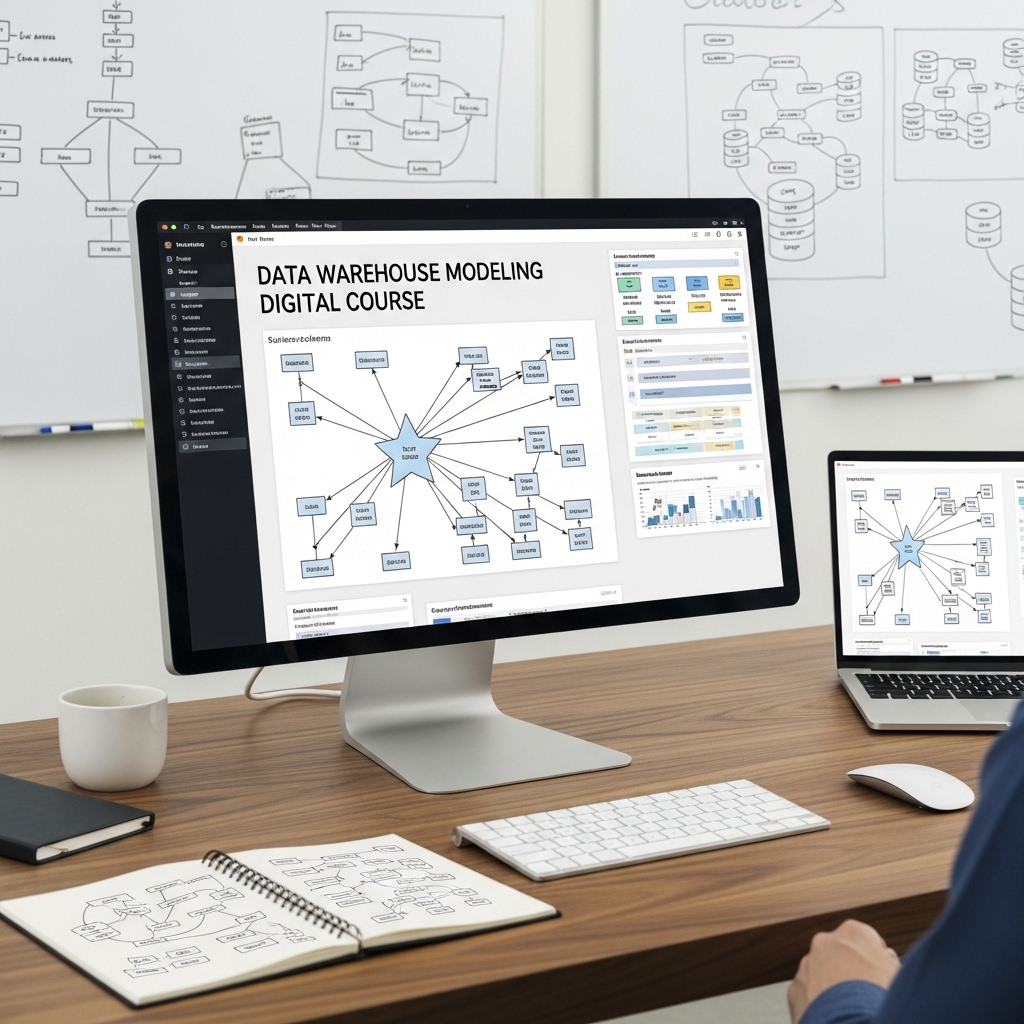
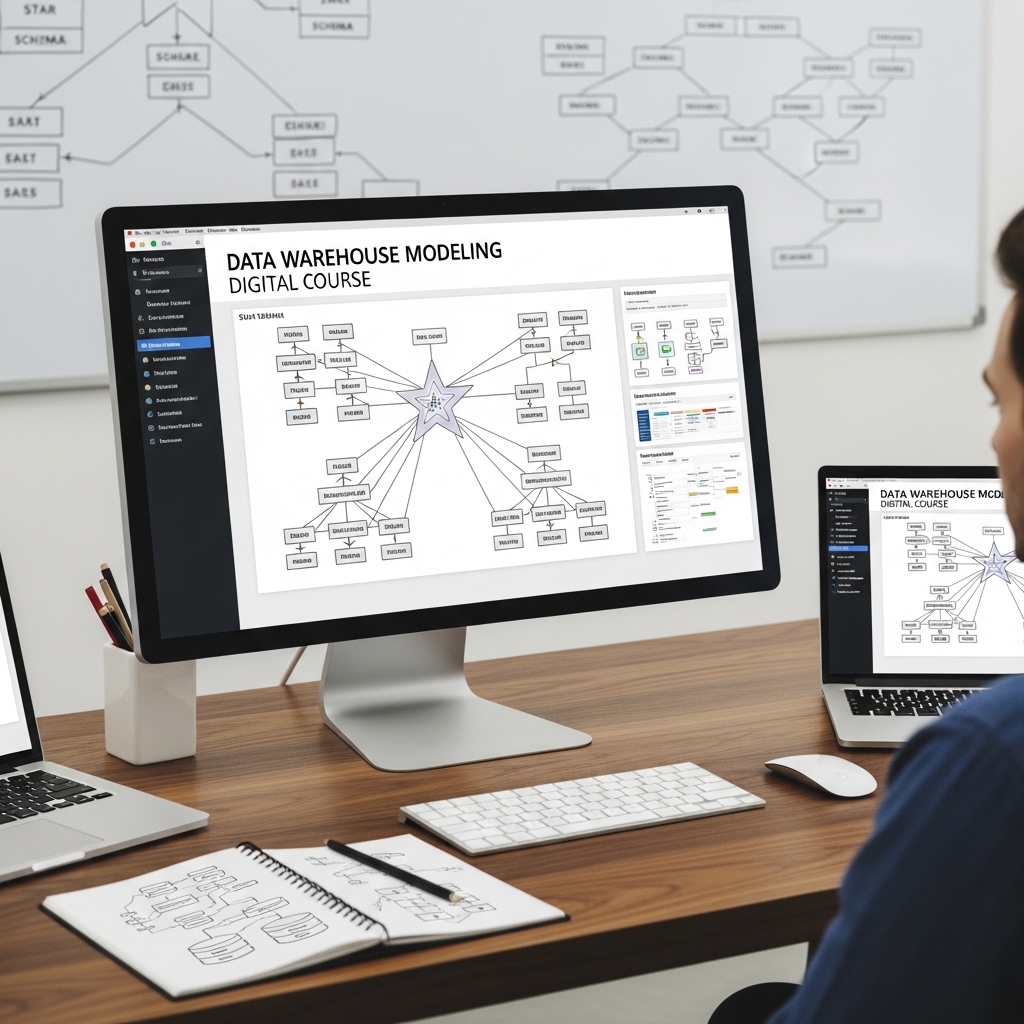

Data Warehouse Modeling Digital Course
🏗️ The Course That Turns SQL Writers Into Data Architects
There is a specific, frustrating experience that happens in almost every data organization at some point. A business stakeholder asks for a “simple” report: revenue by product by month. Three different engineers query the data warehouse and get three different numbers. A meeting is called. It turns out that the orders table and the transactions table each tell a different story, both of them partial. Nobody is sure which one is right, or what “revenue” means in the context of each table’s structure. The meeting produces no resolution and a follow-up ticket to “figure out the data model.”
This is not a data quality problem in the conventional sense. It is a dimensional modeling problem. When data warehouses are built without a clear modeling philosophy, without deliberately designed fact and dimension tables, without a documented grain, without consistent business metric definitions, the result is a collection of tables that individually contain correct data but collectively answer no question reliably. Analysts learn to distrust the warehouse. Stakeholders learn to distrust the analysts. And the data team spends its time in reconciliation meetings rather than delivering insight.
Data warehouse modeling is a discipline. It has a rich intellectual history (Kimball’s dimensional modeling, Inmon’s enterprise data warehouse approach, more recently the data vault methodology and the lakehouse medallion architecture) and a substantial body of accumulated practical wisdom about what works at scale and what breaks under pressure. The problem is that most data engineers learn it on the job, through exposure to other people’s models (including poorly-designed ones) rather than through structured instruction. The mental models form slowly and inconsistently.
The Data Warehouse Modeling Digital Course is a comprehensive self-paced learning package designed to build data warehouse modeling expertise from the ground up, or to fill in the gaps for experienced practitioners who have been modeling intuitively without a complete theoretical framework. This is not a tool tutorial. It’s a rigorous modeling curriculum with extensive worked examples, hands-on exercises with real solutions, implementation templates, and the conceptual vocabulary to articulate and defend design decisions.
📦 Complete Course Package Contents
100% digital product. Nothing ships physically. Your download includes:
Core Course Curriculum (.pdf, 9 modules, 200+ pages of structured instruction)
Module 1: Why Dimensional Modeling Exists (30 pages) The analytical failure modes of operational database schemas when used for reporting. OLTP vs. OLAP design philosophy. Why normalized schemas produce correct storage but poor analytical query performance. The historical development of dimensional modeling as a response to these failure modes. Key concepts: the dimensional model’s primary goals of understandability, query performance, and adaptability.
Module 2: The Building Blocks: Facts and Dimensions (25 pages) Precise definitions of fact tables and dimension tables with extensive examples. Additive, semi-additive, and non-additive facts with implications for aggregation. Degenerate dimensions and when they’re appropriate. Junk dimensions for low-cardinality flags. The role of surrogate keys. Slowly changing dimension preview. Worked examples from three industry verticals: e-commerce, SaaS, and financial services.
Module 3: Grain: The Most Important Decision You’ll Make (20 pages) The grain definition principle in full depth. How grain choice determines everything downstream: what facts can be stored, what dimensions can be joined, what aggregations are valid. The grain declaration exercise. Common grain mistakes: choosing a grain that’s too coarse (losing analytical detail) vs. too fine (creating a fact table that can’t be aggregated meaningfully). Worked examples: defining the grain for a sales fact table, a session event fact table, and a subscription billing fact table.
Module 4: Schema Patterns: Star, Snowflake, and When Each Applies (18 pages) Complete treatment of the star schema and snowflake schema patterns with diagram-annotated examples. The query performance and maintenance trade-offs between the two. Constellation schemas (fact constellation, also known as galaxy schema) for multi-fact warehouse designs. When to denormalize and when normalization serves the analytical use case. The role of conformed dimensions in enabling cross-process analysis.
Module 5: Slowly Changing Dimensions in Full Depth (22 pages) All seven SCD types (Type 0 through Type 6, including the hybrid Type 4 and Type 6) with complete definitions, implementation patterns, and query implications. Most resources only cover Types 1, 2, and 3: this module covers all variants with rigorous treatment. Type 2 SCD implementation patterns in SQL and dbt. The row versioning and effective date approach. Current record flag vs. NULL current_to_date approaches. Performance implications of large SCD Type 2 dimension tables. Mini-dimension pattern for handling frequently changing attributes.
Module 6: Fact Table Patterns Beyond the Transaction (18 pages) The three fundamental fact table types: transactional, periodic snapshot, and accumulating snapshot. When each applies, with worked examples. Factless fact tables and their analytical use cases (event recording, coverage analysis). Bridge tables for many-to-many relationships between facts and dimensions. Multi-valued dimension handling strategies.
Module 7: Data Vault Fundamentals for Modern Warehouses (20 pages) Introduction to Data Vault 2.0 methodology. Hubs, Links, and Satellites: definitions, design principles, and worked examples. When Data Vault is the right choice over dimensional modeling (high source system volatility, regulatory auditability requirements, many-source integration). Data Vault as a raw vault layer with a business vault and information mart on top. Integration patterns between Data Vault raw layer and dimensional mart layer.
Module 8: The Modern Medallion Architecture and ELT Stack Integration (22 pages) The Bronze/Silver/Gold layer architecture in the context of cloud data lakes and lakehouses. How traditional dimensional modeling maps onto the Gold layer. dbt’s role in the modeling layer: model types (staging, intermediate, mart) and how they correspond to the dimensional modeling layers. The modern ELT data stack (Fivetran/Airbyte + dbt + Snowflake/BigQuery/Databricks) and how dimensional modeling principles apply within it. One Big Table (OBT) as an architectural choice and when it’s appropriate vs. anti-pattern.
Module 9: Performance, Optimization, and Modeling for Scale (15 pages) Query performance optimization at the modeling level: clustering keys and partition strategies in Snowflake, BigQuery, and Databricks. Pre-aggregated summary tables vs. runtime aggregation trade-offs. Materialization strategies in dbt (view vs. table vs. incremental). Incremental loading patterns for large fact tables. The impact of model design choices on compute cost in cloud warehouses.
Schema Design Workbook (.xlsx + .pdf, 12 exercises with reference solutions) Twelve real-world dimensional modeling exercises with increasing complexity, each structured as:
- Business context description (2-3 paragraphs)
- Source system schema (ERD diagram)
- Analytical requirements (5-8 specific reporting questions the model must support)
- Blank modeling canvas (empty dimension and fact table grids to fill in)
- Reference solution tab with a complete, annotated model and design rationale notes
Exercise domains include: e-commerce order management, SaaS subscription and usage billing, healthcare appointment scheduling, financial transaction ledger, customer support ticket management, digital advertising campaign performance, inventory and supply chain, user behavior event stream, and two multi-fact constellation exercises for advanced practitioners.
dbt Model Template Library (.sql, 30 templates organized by layer) Production-ready dbt model templates with complete documentation and configuration blocks:
- Staging Layer (8 templates): Source data cleaning and standardization templates for common source types (CRM, transactional database, SaaS API, event stream)
- Intermediate Layer (7 templates): Business logic transformation templates including entity resolution, event sessionization, and metric pre-calculation
- Dimension Models (8 templates):
dim_customer,dim_product,dim_date,dim_account,dim_employee,dim_location, plus a SCD Type 2 snapshot pattern and a mini-dimension pattern - Fact Models (7 templates):
fct_orders(transactional),fct_sessions(periodic snapshot),fct_support_tickets(accumulating snapshot),fct_events(high-volume event fact with incremental materialization), plus three bridge table patterns
Every template includes a complete dbt config block, source/ref declarations, grain documentation comment, business logic inline comments, and schema.yml documentation companion file.
Data Modeling Decision Framework (.pdf, 22 pages) A structured decision guide for choosing between dimensional modeling, Data Vault, and OBT for a given use case. Organized as a decision tree with supporting trade-off matrices. Covers: source system volatility assessment, auditability and regulatory requirements, query pattern characterization, team skill set considerations, and tooling constraints. Includes a one-page cheat sheet version for quick reference in design discussions.
Grain Definition Worksheet (.pdf + fillable .docx) A structured pre-modeling exercise for defining and documenting a fact table’s grain before writing any SQL. Walks through: identifying the business process being modeled, enumerating the candidate grain options, evaluating each candidate grain against the analytical requirements, selecting and documenting the declared grain, and listing the dimensions that are valid at the chosen grain. Includes a peer review section for team sign-off on grain decisions before modeling begins.
Naming Convention Standards Reference (.pdf, 12 pages) An opinionated, comprehensive naming convention guide for every element of a dimensional data warehouse: database and schema naming (layer prefixes), table naming (dim_, fct_, stg_, int_, rpt_ conventions), column naming (surrogate key suffix, natural key suffix, flag column suffix, date vs. timestamp vs. date_id disambiguation), boolean field standards, date/time zone handling conventions, and metric column naming (the difference between order_amount, order_amount_usd, and order_amount_net_usd). Includes a before/after example table showing ambiguous naming transformed into unambiguous naming.
Modeling Glossary (.pdf, 80 terms, 16 pages) A precise, reference-quality glossary covering dimensional modeling, Data Vault, and modern data stack vocabulary. Each entry includes: the term, a precise definition, a usage example in a sentence, common misconceptions or misuses, and related terms. Organized alphabetically with a thematic index (Fact Table Concepts, Dimension Concepts, Schema Patterns, Slowly Changing Dimensions, Data Vault, Modern Stack).
Anki Flashcard Deck (.apkg + .pdf, 120 cards) A spaced repetition flashcard deck in Anki format (.apkg, importable directly into Anki) for memorizing and internalizing key dimensional modeling concepts. 120 cards organized into four decks: Definitions (30 cards), Pattern Recognition (40 cards, “given this scenario, which modeling pattern applies?”), Anti-Pattern Identification (25 cards, “what is wrong with this model design?”), and SQL Patterns (25 cards, “write the query for this modeling operation”). The PDF version provides a printable reference of all card fronts and backs for non-Anki users.
✅ Key Features in Full
Pattern-Before-Syntax Instruction: Every module introduces the conceptual pattern and its design rationale before introducing any implementation syntax. Engineers who learn dimensional modeling through syntax first (by reading dbt documentation or SQL tutorials) often develop correct mechanics without understanding why the model is designed the way it is, which limits their ability to adapt when the standard pattern doesn’t fit the situation. This curriculum prioritizes judgment over mechanics.
Anti-Pattern Gallery: Every major module includes a dedicated anti-pattern section documenting what the wrong approach looks like, what its failure mode is at scale, and how to recognize and refactor it. Anti-patterns covered include: fan traps, chasm traps, over-normalized fact tables, premature aggregation, grain inconsistency within a fact table, SCD Type 2 without current-record filtering, and the “God dimension” anti-pattern.
Complete Worked Solutions: The schema design workbook includes fully worked, annotated reference solutions for every exercise. Solutions are not just the “correct” model: they include design rationale notes explaining why specific decisions were made, what alternatives were considered, and what trade-offs the chosen model makes. This makes the workbook useful for self-directed learners who can compare their work to a reference solution and understand where and why their approach differed.
🎯 Built For These Learners
- Data engineers who have been writing pipelines and SQL but haven’t formally studied dimensional modeling and want to close that gap
- Analytics engineers who work with dbt daily but want the deeper architectural foundation behind the staging/mart layer structure
- Data analysts who write complex SQL against the warehouse and want to understand the modeling decisions behind the tables they query
- Engineering team leads evaluating or rebuilding their team’s data warehouse architecture and needing to ground the decision in solid modeling theory
- Career changers from software engineering into data engineering who have strong programming skills but limited data modeling background
📈 What Changes After This Course
The difference this curriculum creates is not primarily syntactic. It’s the development of modeling judgment: the ability to look at a business question, understand its analytical requirements, and translate those requirements into a dimensional model that answers it reliably, efficiently, and maintainably. That judgment doesn’t come from reading documentation. It comes from working through the decision points, the trade-offs, and the failure modes that this course is built around.
After completing this curriculum and its exercises:
- Designers can define grain precisely and defend that choice against alternative grain options
- Schema designs serve the analytical requirements rather than mirroring the operational source schema
- SCD Type 2 is implemented correctly on the first attempt rather than refactored after finding historization problems
- Data vault is understood as an architectural choice with specific trade-offs, not a mystery pattern
- Anti-patterns are recognizable on sight, whether in someone else’s model or in a first draft
💾 Digital Delivery and File Formats
Delivered as a structured ZIP archive upon purchase, organized by module and component type.
| Included File | Format(s) |
|---|---|
| Core Course Curriculum (9 modules) | |
| Schema Design Workbook (12 exercises + solutions) | .xlsx + .pdf |
| dbt Model Template Library (30 templates) | .sql + .yml |
| Modeling Decision Framework | |
| Grain Definition Worksheet | .pdf + .docx |
| Naming Convention Standards Reference | |
| Modeling Glossary (80 terms) | |
| Anki Flashcard Deck (120 cards) | .apkg + .pdf |

Reviews
There are no reviews yet.