
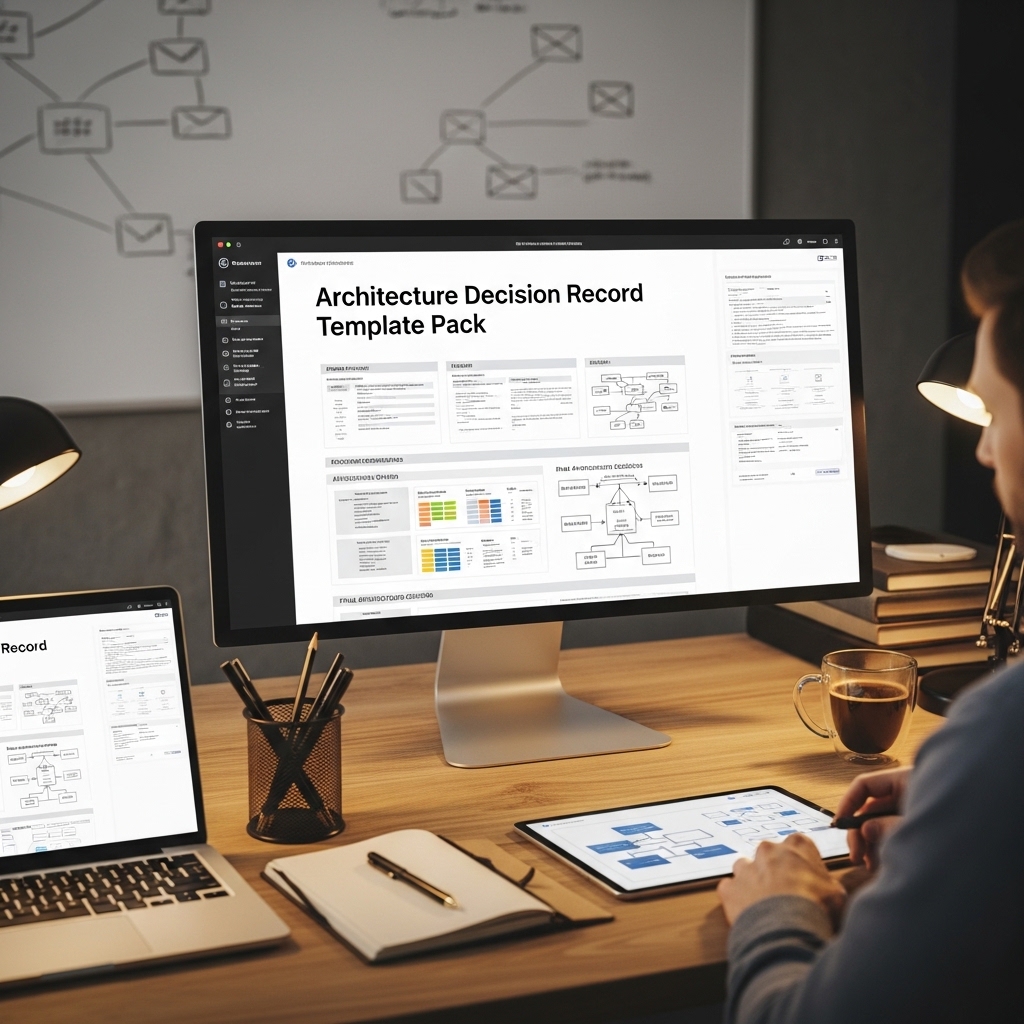


Architecture Decision Record Template Pack
🏛️ Decisions Are Made Every Week. Why Are 90% of Them Undocumented?
Here is a scenario that plays out in nearly every engineering organization at some point. A critical architecture decision was made eighteen months ago. The engineer who led that decision has since left the company. The decision is now the subject of a heated debate: should the team reverse it? The problem is that no one remembers with confidence why the decision was made in the first place. There were constraints at the time that may no longer be relevant. There were alternatives that were seriously considered and rejected for specific reasons. There was context that made one option obviously correct. All of that context is gone. The team is debating in a vacuum, relitigating a closed question with none of the information that was available when the question was first answered.
This scenario is so common it has a name in organizational theory: decision archaeology. Teams spend engineering cycles digging through commit history, Slack threads, old sprint notes, and the institutional memory of whoever has been around the longest, trying to reconstruct why the system is the way it is. Every hour spent on that archaeology is an hour not spent on forward progress.
Architecture Decision Records are the engineering profession’s answer to this problem. They are lightweight, structured documents that record the context, the decision, the alternatives considered, and the consequences of significant architectural choices, stored alongside the code in the repository where the decision lives. The concept is simple and the evidence for its value is overwhelming. The obstacle has always been the activation energy required to start: designing the template structure, deciding what belongs in each section, building the index system, integrating with existing tools.
This pack eliminates every piece of that activation energy. The Architecture Decision Record Template Pack is the most complete, immediately deployable ADR template collection available as a digital product. Ten scenario-specific templates, a master index system, a Notion database, a status lifecycle framework, and a complete supporting toolkit, all designed to get a team from “we don’t write ADRs” to “we have a functioning ADR practice” in a single afternoon.
📦 Complete Digital Download Contents
Digital download only. Nothing physical ships. Your purchase gives you instant access to:
Core ADR Template Set (.md, 10 scenario-specific templates) Unlike generic ADR templates that ask the same questions regardless of what decision is being made, this set provides 10 separate templates, each pre-tuned to the questions that matter for a specific type of architectural decision:
- Database Technology Selection: Storage model rationale, consistency requirements, query pattern fit, operational complexity assessment, scaling ceiling analysis
- API Design and Contract Decision: Protocol selection (REST/GraphQL/gRPC), versioning strategy, authentication approach, backward compatibility commitment
- Infrastructure Layer Decision: Cloud provider/service selection, self-managed vs. managed, cost model comparison, lock-in risk assessment
- Authentication and Authorization Strategy: Identity provider selection, token format and lifecycle, permission model, session management approach
- Caching Strategy Decision: Cache location (client/CDN/application/database), invalidation strategy, consistency trade-offs, failure mode behavior
- Service Boundary Definition: Domain reasoning, decomposition rationale, communication protocol between services, data ownership assignment
- Data Serialization Format: Format selection (JSON/Protobuf/Avro/MessagePack), schema evolution approach, cross-language compatibility requirements
- CI/CD Toolchain Selection: Pipeline architecture, test stage sequencing, deployment strategy, rollback mechanism
- Observability Stack Decision: Three-pillar coverage approach, vendor vs. open-source trade-off, data retention and cost model, instrumentation strategy
- Frontend Framework Adoption: Rendering strategy, bundle architecture, state management philosophy, migration path from prior solution
ADR Index Table Template (.xlsx + .md) A master decision register with pre-built columns for: decision ID (auto-formatted), decision title, status (Proposed/Accepted/Deprecated/Superseded, with dropdown validation), date proposed, date accepted, decision author, affected systems/services, linked ADR document, and superseding ADR reference (for tracking decision evolution). The .xlsx version includes conditional formatting that highlights deprecated and superseded decisions in muted colors for visual scanning. The .md version is formatted for rendering as a table in GitHub or GitLab wikis.
ADR Status Lifecycle Diagram (.pdf + editable .svg, two versions) A visual flowchart documenting the complete lifecycle of an ADR from Proposed state through Accepted, Deprecated, and Superseded, with annotated decision points at each state transition: what triggers a move from Proposed to Accepted, when an Accepted decision should be marked Deprecated vs. Superseded, and how Superseded decisions should link to their replacements. The editable SVG version allows teams to customize the flow or add organization-specific states.
Context Canvas Worksheet (.pdf, fillable) A structured pre-writing exercise to complete before writing the ADR itself. The canvas guides the author through: problem articulation (what specifically are we deciding and why is a decision needed now), constraint mapping (technical constraints, organizational constraints, time constraints, budget constraints), stakeholder impact matrix (who is affected by each alternative and how), and decision criteria prioritization (ranking the criteria that will determine the right choice). Completing the canvas before writing the ADR dramatically reduces the number of revision cycles the document goes through.
Alternatives Comparison Matrix Template (.xlsx) A professional scoring matrix for objectively evaluating 2 to 5 architectural alternatives against a weighted set of criteria. Pre-populated with two criterion categories (Technical Fit and Operational Factors) and sub-criteria rows that can be edited. Includes: a weight assignment row for prioritizing criteria, a 1-5 scoring scale with behavioral anchors defining what each score means (not left to arbitrary interpretation), an auto-calculated weighted total per alternative, and a decision summary section. A second tab provides a worked example using a real database selection scenario to demonstrate correct usage.
Consequences Mapping Template (.md) A structured format for documenting both positive and negative consequences of an accepted decision. Organized into four quadrants: immediate positive consequences, immediate negative consequences or trade-offs, long-term positive consequences, and long-term risks or liabilities. Each quadrant includes helper prompts asking specifically about: performance implications, operational complexity changes, team skill requirements, vendor or technology lock-in, and downstream service impacts. This level of consequence documentation is what separates genuinely useful ADRs from records that merely state what was decided without explaining what it means.
ADR Review Checklist (.pdf) An 18-point quality checklist for evaluating whether an ADR draft is ready to be marked “Accepted.” Organized into four categories: Completeness (does it include all required sections with substantive content), Clarity (is the problem statement unambiguous, are the alternatives meaningfully distinct), Honesty (does it document real trade-offs rather than just justifying a predetermined choice, does it acknowledge uncertainty), and Durability (will a reader in two years understand this without asking for additional context). Designed to be used by both the ADR author before submitting and by reviewers before approving.
Notion ADR Database Template (.json, importable) A complete Notion database pre-configured with all ADR fields, status select options (with color coding), relational properties linking to a Services database, formula fields for decision age calculation, and a set of pre-built views: All Decisions (table view), Active Decisions (filtered to Accepted status), Recent Decisions (sorted by date, last 30 days), and Decisions by Service (grouped by affected service). Importable via Notion’s block import or JSON database import.
Retroactive ADR Worksheet (.pdf + .md) A specialized template variant for documenting past decisions that were never formally recorded. Includes additional fields not present in forward-looking templates: “Best available reconstruction of context at the time,” “Confidence level in this reconstruction (High/Medium/Low),” “Sources consulted for reconstruction,” and “Open questions about original decision context.” Designed to give retroactive documentation appropriate epistemic humility without making it useless.
✅ Key Features Explained
Scenario-Specific Question Architecture: The wrong questions produce the wrong documentation. A generic ADR template asking “what alternatives were considered” does not prompt the right analysis for a caching decision (where the questions should be about invalidation strategy and consistency guarantees) or a service boundary decision (where the questions should be about domain ownership and data coupling). Each template in this pack was designed around the specific failure modes and trade-off dimensions relevant to its decision type.
Short-Form and Long-Form Variants: Two of the ten templates (Database Selection and API Design) include a short-form variant capped at one page for decisions where a full treatment isn’t warranted. Every other template has implicit length guidance through section design. The philosophy is that the right length for an ADR is the length required to make the decision reproducible and the reasoning auditable, no more.
Decision Archaeology Support: Retroactive documentation is treated as a first-class use case. The Retroactive ADR Worksheet is not a simplified version of the standard template; it is a purpose-built variant that handles the specific epistemic challenges of reconstructing past decisions, including uncertainty, conflicting recollections, and missing context.
Supersession Chain Discipline: Every template includes a structured “Supersedes / Superseded By” field with formatting guidance for maintaining clean links between related decisions. This keeps the ADR index coherent as the system evolves: you can trace the genealogy of any decision, seeing what it replaced and what eventually replaced it.
🎯 Who This Pack Is Designed For
- Staff and principal engineers who have been advocating for ADRs but didn’t want to build the template system themselves
- Engineering managers whose teams are growing fast enough that “everyone knows the context” is no longer true
- Organizations undergoing significant re-architecture where the volume of consequential decisions requires a systematic documentation approach
- Teams preparing for SOC 2, ISO 27001, or enterprise compliance reviews where technical decision-making processes are subject to audit
- Distributed and async teams where decisions are made without everyone in the room, and documentation is the primary communication medium
- Acquirers and acquired teams where due diligence or integration requires rapid comprehension of architectural choices made by another organization
📈 The Compounding Return on Decision Documentation
The value of ADRs is not linear. A single ADR provides modest value: one decision is documented. A library of 50 ADRs provides exponentially more: the entire architectural evolution of the system is traceable, new engineers can reconstruct years of technical history in an afternoon, and the team’s collective decision-making quality improves because past reasoning is visible and learnable from. This pack is the foundation for building that library.
- Onboarding conversations get dramatically shorter because new engineers can self-serve architectural context
- Architecture reviews become more substantive because they reference documented history instead of reconstructing it
- Post-mortems gain context faster when the architectural decisions relevant to an incident are recorded
- Teams stop accidentally relitigating closed questions because the decision and its reasoning are visible
- Technical debt discussions become evidence-based: you can reference the ADR that introduced a known trade-off and evaluate whether the conditions that justified it still hold
💾 Digital Delivery and File Formats
Delivered instantly as a ZIP archive upon purchase. No login required. No subscription.
| Included File | Format(s) |
|---|---|
| Scenario-Specific ADR Templates (10 templates) | .md each |
| ADR Index Table | .xlsx + .md |
| Status Lifecycle Diagram | .pdf + .svg |
| Context Canvas Worksheet | .pdf (fillable) |
| Alternatives Comparison Matrix | .xlsx (2-tab) |
| Consequences Mapping Template | .md |
| ADR Review Checklist (18 points) | |
| Notion ADR Database | .json (Notion import) |
| Retroactive ADR Worksheet | .pdf + .md |

Reviews
There are no reviews yet.